Create Web Sites

  • Subscribe to our RSS feed.
  • Twitter
  • StumbleUpon
  • Reddit
  • Facebook
  • Digg

Thursday, 16 February 2012

A Question on Transitions

Posted on 21:00 by Unknown
by Eric Fortune

Hey Eric,


I had a quick question I was hoping you could help me with. You say that you use thin layers of acrylic washes, are you using regular acrylics, liquid acrylics or something else? I've been using regular Golden acrylics for washes but when I thin down the paint too much the pigment doesn't go down too smooth. Also, with whatever you're using, are you able to pull any of the color back up should you need to? I like using acrylic washes b/c of the muted tones I can get but have had to switch to watercolors b/c of the less than smooth washes and ability to pull color back up but am now getting colors that are way too bright.


Anyway, thanks for the help, hope I'm not taking up too much of your time.


I shot another video to try and answer this question. I put emphasis on experimenting and practicing. The more we practice the more we learn and refine our work, technically and conceptually. Another important factor to acknowledge is that these things can take a lot of time and patience. But if it's worth doing, it's worth doing right. If you're not happy with how you're paintings are turning out perhaps you're not quite finished yet.


In this particular case it seems the person may be going back and forth between watercolors and acrylics. I have nothing against mixed mediums. So perhaps a combination of the two will suit you best. As for color, I usually keep a test strip of watercolor paper that I brush colors on to in order to see if the colors actually look the way I want them to. Test out your colors on a sample sheet of paper first. If it's too intense make appropriate adjustments. With my technique I would either tone it down with other colors and/or thin it out with more water. Hope this helps.


Read More
Posted in | No comments

Studio Time

Posted on 06:37 by Unknown
by Donato


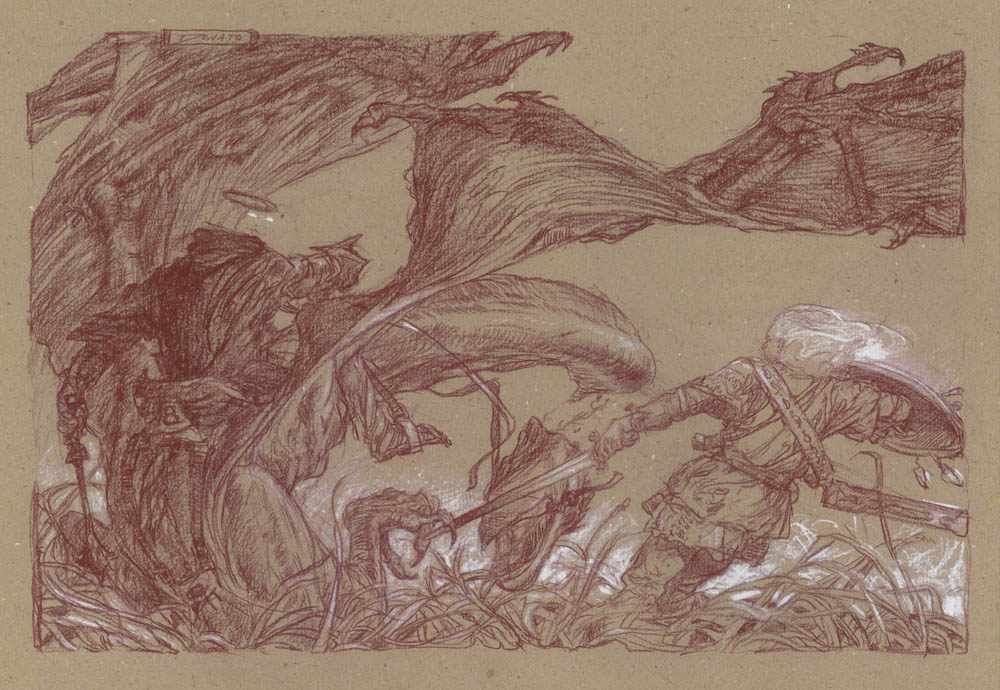
After those amazing posts these past fews days from my fellow Muddy Buddies, I am not even going to attempt to stand in their shadows with a lame attempt at advice.  Rather, here are a few shots of what's keeping me in my dirty painter's pants these weeks, and reiterate what I always say...back to work!


The Shipwreck (seen above) is on the drafting table now, and will likely be there for quite a few weeks more... overall size is 40" x 72", Oil on canvas.  The astronaut in progress is for a showing at the Richard J. Demato Gallery in Sag Harbor, NY later this year.


Promethean Seed, 36" x 48", Oil on Panel (in progress)


Lastly, some more Middle-earth drawings (which I always love to tackle!). Ents Roused and Zirak-zigil with Gandalf and the Balrog were for my Limited Edition Book.


Read More
Posted in | No comments

Tuesday, 14 February 2012

MicroVisions 7 Contributors Announced

Posted on 21:01 by Unknown
-Irene Gallo


MicroVisions 7 has begun and it’s a stellar line up.


For those new to the event, each year Greg Manchess, Dan Dos Santos, and I ask a dozen artists to create a 5x7 painting of their choosing. These miniatures are exhibited at the Society of Illustrators and then placed on auction, with all proceeds going to the Society’s Student Scholarship Fund. This year’s contributors are:

Scott Bakal

Julie Bell

Scott Brundage

Brian Despain

Nathan Fowkes

Rebecca Guay

Scott Gustafson

John Picacio

Dan Dos Santos

Peter de Seve

Chris Rahn

Terryl Whitlatch
The exhibit will run in May, with the auction taking place late in the month. We will post details as the event draws near.


The Society scholarships are among the illustration industry’s toughest awards. This year, over 8,000 entries were examined by 25 judges. Just over 200 students will be accepted into the exhibit, about half of them will earn cash awards. Not only do these awards help subsidize students financially, they also go a long way to boost the confidence of young artists (and their nervous parents) by proving their voices stand out amongst thousands of others. It’s never long before you start seeing the winners on their way to becoming the field’s biggest names. John Jude Palencar, James Jean, Tomer Hanuka, Dan Dos Santos, and many others have become noted illustrators since the Scholarship’s inception in 1981.


Once again, I would like to thank the artists involved for heir generosity. The illustration community is incredibly supportive. Not every profession would donate time and energy to support their future competition.
Read More
Posted in | No comments

Collaborative Painting

Posted on 00:52 by Unknown
-Dan dos Santos


Here is the latest installment of the 'Alien' series I do for Daw books, titled 'Alien Diplomacy'. This one was a lot of fun to work on. Not so much because of the subject matter, but because of the company.


The deadline on this piece was really tight, and I honestly thought I would have to turn the job down. That's not something that I, or the client, wanted to do. I had already painted the first 4 covers in the series, and it would be a shame to just hand that off to someone else. So I did what any person does when they're in a jam... I asked for help.


Knowing there was no way to get the job done in the allotted time on my own, I asked fellow illustrator, and good friend, Dave Palumbo to help me out on this piece. Dave and I have really similar working methods (right down to the substrate we both use), so I knew he would be a good partner on this piece. I also know that he has similar tastes to myself, and was experienced collaborating with other artists.


Dave traveled from Pennsylvania to my home in Connecticut, and over the course of 4 days, we managed to turn out a rather complicated piece from start to finish.


I've done collaborations before, and not always with great results. I think this collaboration was particularly successful due to a few factors:

1. As I mentioned, Dave and I have very similar working methods.

2. The 'look' of the series had already been established, so we had a clear goal in mind as to what the final result should look like.

3. Rather than both paint a little bit of everything (and likely un-do a lot of each other's work), we decided to divvy up the various elements of the painting. I would paint one specific element, Dave another.


The collaboration actually started before Dave got to my house. Days prior, we bounced sketches back and forth via email, refining one another's ideas, and getting the Editor's approval before Dave drove up.


Once here, Dave and I immediately went reference hunting. We took a trip around town, and even stopped at Wal-Mart, photographing all sort of junk that would help us compose the robotic elements of the painting. Industrial backhoes, Transformers toys, and even vacuum cleaners all made their way into the painting.


We hired one of my favorite models that same day for a late night shoot, and later that night settled on a pose.


Dave helps with the drapery as the model poses.


We spent the entire next day compiling the reference, making sure we were both happy with the composition. Dave then began the process of transferring the image to the board, and did a rough acrylic lay-in.


Once the lay-in was completed, Dave took a well-deserved break, and I began the process of painting the background elements... working well through the night. When Dave woke up the next morning, he began painting the mid-ground. We alternated like this, back and forth, Dave working during the day, and me at night, so that we could clock a good 16 hours worth of work on the painting each day.


Just 4 days after his arrival, we had a pretty impressive, albeit completely wet, painting to show for it.


First thing the next day, we took a drive to a local photographer that I often use to scan my paintings. With a 10 foot flatbed-scanner at our disposal, we were able to get a wonderful hi-rez scan of the image, regardless of it being wet.


A few hours later, scan in hand, I imported the image into Photoshop, and began making adjustments. I digitally added the male figure into background, as well and the furry critters up front. Both were elements that were really important to the story, so they had to be there. However, Dave and I discussed these elements early on, and both felt that the original painting would be much stronger without them. So we knew that we were going to add them digitally before we even started.


The final cover with additional characters.
There are a couple of serious considerations when collaborating with someone on a professional job. Most notably, who will retain the copyrights, and the original art? I was tempted to hire Dave to help me as a work-for-hire arrangement, as this would keep things really simple. Dave would be well compensated, and the painting, for all legal purposes would be mine. I decided not to do this for two reasons.


Firstly, this would mess up my taxes. It would mean me claiming incoming I didn't actually receive, or possibly having to list Dave as an employee. That is territory I didn't want to tread.


The other reason, and the more important of the two, was that I thought it would be insulting. Dave is really talented, and I didn't want him to be a ghost on this project. I wanted his input, and fully expected that his sensibilities would show through in the final work. As such, it was only fair that he receive credit too. In the end, Dave and I each own half the copyright, both received cover credit, and each invoiced the client separately. I currently have the original art, but it technically belongs to both us. Should we decide to sell it, we would both split the income.
Read More
Posted in | No comments

Monday, 13 February 2012

Fanzines

Posted on 02:30 by Unknown
by Arnie Fenner

Above: Tim Kirk and George Barr collaborated on this lovely and whimsical drawing for Graphic Illusions.


In the pre-Internet era, young artists, writers, and entrepreneurs often combined their interests to produce fanzines (or "semi-pro zines" if they paid for content), small press publications that filled a void in the marketplace and actually advanced the appreciation for the subjects (comics, SF, film, horror, etc.) highlighted in the magazines. Artists and authors were able to hone their craft or, if they were already working professionals, experiment with subjects or ideas they normally didn't have the opportunity to explore; publishers wet behind the ears were able to learn the ins and outs of the business while refining their design and editorial skills; readers were able to get something more than what the professional houses were putting on the news stands. Win, win, win.


Above: The first appearance of what became Superman, written by Jerry Siegel under the pseudonym of Herbert S. Fine with art by Joe Shuster.


Fanzines were a natural extension of science fiction fandom, which in turn spawned comics fandom; it's well known that Jerry Siegel and Joe Shuster first created Superman for their fanzine Science Fiction #3 in 1933 (and eventually sold the character to National Allied Publications, much to their eventual sorrow). Ray Bradbury, Harlan Ellison, and Ray Harryhausen all produced fanzines in their youth, creating crude yet enthusiastic journals with stencils and mimeograph machines. Stephen King's sold his first story, "I Was a Teenage Grave Robber," to the amateur journal Comics Review, while Tim Kirk built his reputation doing cartoons for numerous fanzines, eventually capitalizing on his recognition to be the artist for the first Lord of the Rings calendar from Ballantine Books. Tim went on to design parts of Disneyland, Disney World, and Epcot and is currently working on designs for the Hong Kong Disneyland.


With the advent of off-set printing and machine saddle-stitch binding, fanzines not only became something of a higher-quality training ground for aspiring creatives, but they eventually began to compete with professional publishers for talent, advertisers, and customers. Trends, ideas, styles, and concepts were many times tried out in the more experimental amateur arena first before being adapted by the mainstream.


Now days, with the dominance of the Internet, chain bookstores, and professional publications that address many of the subjects and interests that used to be the domain of the small presses (combined with an overall decline in magazine sales), fanzines are no longer as common or influential as they once were. But there was a time when the most exciting part of the field was the small press publications. Here are a few of my favorites.


Above: Heritage was an ambitious, 2-issue fanzine devoted to Alex Raymond's Flash Gordon. It featured articles, photos, and new Flash stories by Jeffrey Jones and Frank Brunner among others.


Above: Tom Reamy's Trumpet was one of the best designed, best illustrated, and best written fanzines of its day. This exceptional over by George Barr was drawn entirely in different color ballpoint pens.


Above: Wally Wood was responsible for witzend and called on many of his fellow artists—including Reed Crandall, Frank Frazetta, and Leo Dillon—to make it one of the most exciting fanzines... ever.


Above: Squa Tront, published by the late Jerry Weist, kept the interest in EC Comics and its creators alive for a new generation. The cover is by Roy Krenkel.


Above: Bookseller Bud Plant was one of the publishers of Promethean Enterprises. The fanzine helped bridge the gap between Underground and Mainstream comics and featured early work by Robert Crumb and Robert Williams.


Above: Phase was one of the slickest fanzines ever produced and featured stories by Neal Adams and Rich Buckler that were later picked up and reprinted by professional publishers. The cover painting by Ken Barr was sold by Heritage Auctions several years ago for a tidy amount.


Above: Only one issue of Frazetta appeared (though it went into a second printing with a different cover): it was an early precursor to the Frank Frazetta phenomenon that was to come. A "sort-of-but-not-really" second issue appeared as part of the Burroughs Bulletin series, but it was something of a cheat for fans that had paid for 3-issue subscriptions to Frazetta to the publisher, Vern Coriell.


Above: Bernie Wrightson (who drew this cover), Jeffrey Jones, Michael Kaluta, and Bruce Jones combined their talents into a single volume of Abyss. A kind of "The Studio" in training, it gave everyone a nice glimpse of things to come.


Above: Richard Corben (who drew this cover) and Robert Kline provided stand-out art for writer Jan Strnad's Anomaly.


Above: Richard Powers painted this cover for Andrew Porter's long-running Algol. The magazine featured other excellent covers by John Schoenherr and Vincent Di Fate, who also wrote a long-running column about SF artists, something of a first for our field.

Read More
Posted in | No comments

Sunday, 12 February 2012

Quilt project

Posted on 03:00 by Unknown


by Petar Meseldzija


A few months ago,
while I was at IlluXcon, LizAnn Lizotte approached me and ask if I would be
willing to participate in a quilt project. She asked all artists who were present
at the show to do a sketch, or a painting, on a little square of cotton cloth.
She would then put these painted patches together and make a quilt. When the
job is finished, Pat Wilshire will auction it off to raise funds for art student
scholarships.


Other artists of note
included in the project are: Justin Gerard, Donato Giancola, Raoul Vitale, Omar
Rayyan, Vincent Villafranca, Matt Stewart,  Jordu Schell,  John Harris, Chris Moeller,  Allen Williams, Jeremy Caniglia, Eric Velhagen,
Tom Taggart, Didier Graffet,  Soutchay
Soungpradith, among others.


So, I said yes, and
brought my piece of cloth home, in order to make a quick oil sketch
of…something. The size of the cotton patch was about 4 ½ X 4 ½ inch, or 11 X 11
cm. The deadline for delivering the painted patch was the beginning of January,
but because of my busy schedule, I was not able to meet the due date. Then, at
the beginning of February, when I was asked if my little sketch was finished, I
felt bad about not keeping my promise and decided to “punish” myself by making
a little painting, instead of making just a quick sketch in color. So, I did
this little painting of a silly giant.


I was surprised to discover how much fun I had while making this little painting. The cotton cloth was very finely woven and
it was surprisingly easy and joyous to apply the oil color to it. I than
realized that I could do some little experiments and try to find out how this
miniature format would fit me. The experience was very refreshing
and insightful and I decided to do more of this kind of little silly paintings.
If my busy schedule permits it, I might do a couple of them and bring it
with me to the Spectrum Live show. So, if you have always dreamed of having an
original Meseldzija in your collection, but did not have enough funds to
finance this dream, this is your chance. With the help of just a couple of
hundred bucks you might persuade me to sell one of these little paintings to
you.


See you in Kansas City in May!


Read More
Posted in | No comments

Friday, 10 February 2012

Sam Weber interview w/ Dan dos Santos

Posted on 21:01 by Unknown
-Dan dos Santos


Sam Weber did a brief radio interview with me this past Wednesday. If any of you are interested, the podcast is now available for streaming and/or download right HERE.


Or you can just click the player below:


Read More
Posted in | No comments
Newer Posts Older Posts Home
Subscribe to: Posts (Atom)

Popular Posts

Categories

  • Dan dos Santos
  • Justin Gerard
  • Paolo Rivera

Blog Archive

  • ▼  2012 (266)
    • ▼  September (4)
      • SiDEBAR interview with Michael Kaluta
      • 2012 Hugo Award Winners
      • Painting Spider-Man
      • Sergio Toppi 1932-2012
    • ►  August (36)
    • ►  July (33)
    • ►  June (36)
    • ►  May (36)
    • ►  April (26)
    • ►  March (31)
    • ►  February (30)
    • ►  January (34)
  • ►  2011 (234)
    • ►  December (25)
    • ►  November (34)
    • ►  October (36)
    • ►  September (27)
    • ►  August (29)
    • ►  July (35)
    • ►  June (31)
    • ►  May (17)
Powered by Blogger.

About Me

Unknown
View my complete profile